


How Regulation is Shaping Innovation in Investment Funds in Kenya
Scroll through social media for a few minutes, and a pattern emerges: the next promotion, the next milestone, the next financial win. The message is subtle but clear: humans are wired to chase the next big thing. That instinct to reach for something better does not stop at careers or lifestyles. It follows investors into markets. Simply put, no matter how disciplined or conservative investors claim to be, they still hunger for superior returns.
In Finance, this instinct is often framed as the pursuit of “alpha” (returns that outperform a benchmark). Over time, this appetite has placed a quiet pressure on Kenya’s traditional Fund structures, particularly those designed to prioritize safety over flexibility. The result? The push to an end of an era of “lazy investing”. As aggressive market disruptors challenge the old guard, Fund Managers are being forced to innovate. They must now design strategies that move in tandem with the complex behavioral shifts seen in modern investors. At the same time, shifts in the regulatory environment, particularly the Capital Markets Authority (Collective Investment Schemes) Regulations and introduction of Alternatives Fund structures have begun to influence how the industry adapts.
Examples of these changes can be seen in the 2023 Collective Investment Schemes (CIS) Regulations as shown below:
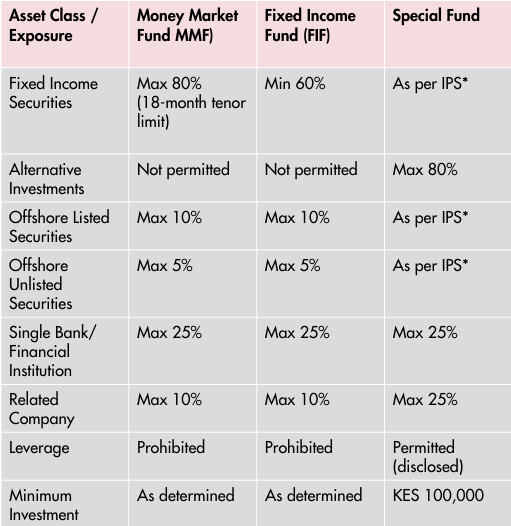
*IPS = Investment Policy Statement
Source: Capital Markets (Collective Investment Schemes) Regulations, 2023
Tightening the Rules of Traditional Funds
Kenya’s traditional Fund structures i.e. Money Market, Fixed Income and Balanced Funds have long been the backbone of the investment landscape. They are familiar, accessible, and trusted, especially by retail and risk-averse investors. Their appeal lies in predictability. These Funds are designed to deliver steady returns with relatively low volatility, and clear investment guidelines. However, as the industry has grown, so too has the emphasis on risk management.
Regulatory frameworks governing these Funds now impose tighter exposure limits to reduce vulnerabilities within portfolios. These safeguards reflect lessons from past instances where excessive concentration or weak controls in certain firms undermined Fund performance and investor confidence.
These constraints serve a clear purpose: investor protection. By limiting exposure to any single issuer, asset class, or geography, regulators ensure that systemic shocks don’t disproportionately affect retail savers. The 18-month tenor limit on Money Market Funds (MMFs), for instance, prevents duration risk while maintaining liquidity. However, these safeguards can also produce unintended market dynamics. When Funds operate under near identical rules, they inevitably end up fishing in the same pond. Portfolios begin to resemble one another and differentiation becomes difficult. This return compression became especially visible after the 2024 interest-rate cycle. As Treasury bill yields eased and the supply of attractive short-dated instruments tightened, competition intensified.
Funds were pushed into the same government securities, and high-quality assets and returns across Funds began to cluster tightly together. The result was a yield treadmill: safe, orderly and regulated but offering little sense of progression. Traditional Funds did exactly what they were designed to do. What they could no longer do, however, was innovate.
How Special Funds Are Filling the Gap
When every road is tightly regulated, markets eventually look for a new lane. Within Kenya’s landscape, one such avenue has taken shape in the form of Special Funds. Unlike Money Market or Fixed Income Funds which follow standardized limits, Special Funds limits are set out clearly in an Investment Policy statement (IPS) formulated by the Fund Manager. Each Fund is reviewed and approved by the Capital Markets Authority on a case-by-case basis. This means that Special Fund A can look entirely different from Special Fund B. Their risk profiles, asset allocations, and performance ceilings are determined by the specific internal limits set by the Fund Manager.
Numbers Don’t Lie
The market response has been swift. In a span of a year (Q3 2024 to Q3 2025), Special Funds have grown from an estimated KES 62.3 Bn to KES 137.8 Bn, a 121.1% increase, overtaking Fixed Income Funds as the second largest segment of Kenya’s collective investment market.
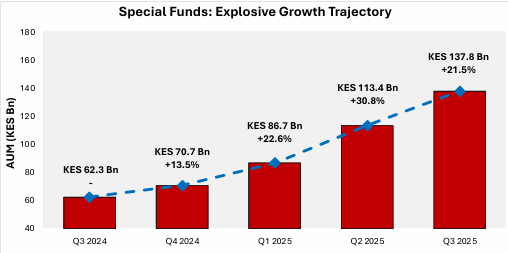
This growth reflects two realities. First, investors remain cautious but they are no longer content with returns that barely keep pace with inflation. Second, Fund Managers now have a structure that allows them to design outcome-driven strategies: portfolios that can diversify geographically, manage currency exposure or access return sources that traditional mandates previously ruled out. Recent approvals for offshore-focused Funds, foreign currency-denominated products and multi-asset Funds highlight this gradual evolution in the market.
What This Means
The emergence of these vehicles does not diminish the relevance of traditional Unit Trusts. For many investors, Money Market and Fixed Income Funds continue to represent their first formal step beyond a bank deposit. Their appeal lies in their simplicity and accessibility: high liquidity, low minimum entry amounts, capital preservation and relatively low risk. These Funds play a foundational role in deepening financial inclusion and cultivating disciplined saving and investing habits.
However, as the investor base becomes more diverse and financial markets deepen, it is natural that different structures emerge to meet different objectives. In that sense, the evolving landscape may be less about replacing Traditional Funds and more about expanding the range of tools available to investors. Ultimately, the choice of structure, whether a traditional Fund or a more specialized vehicle, should come down to an investors’ risk tolerance, liquidity needs and investment horizon.
Written by Rita Nyairo
Senior Investment Analyst, Jubilee Asset Management Limited
Jubilee Asset Management Limited is licensed as a Fund Manager by the Capital Markets Authority (CMA)
Information and content
The information in and content of this publication are provided by Jubilee Asset Management Limited as general information about the company and its products and services. Jubilee Asset Management Limited does not guarantee the suitability or potential value of any information or particular
investment source. The information provided is not intended to, nor does it constitute financial, tax, legal, investment or other advice. Before making a decision or taking any action regarding your finances, you should consult a qualified financial adviser. Nothing contained in this publication constitutes a solicitation, recommendation, endorsement or offer by Jubilee Asset Management Limited; it is merely an invitation to do business. Jubilee Asset Management Limited has taken and will continue to take care that all information provided, in so far as this is under its control, true and correct. However, Jubilee Asset Management Limited shall not be responsible for and therefore disclaims any liability for any loss, liability, damage (whether direct or consequential) or expense of any nature whatsoever which may be suffered as a result of or which may be attributable, directly or indirectly, to the used of or reliance on any information provided.